
Building Connection in the Digital Age
A 6-minute read | Based on current research from the U.S. Surgeon General, CDC, and University of Michigan
Loneliness is one of the most overlooked challenges facing older adults today. While it is often dismissed as simply part of getting older, research tells a very different story. Connection is possible at any age, and when used thoughtfully, today’s technology can be a powerful bridge to the people and communities that matter most.
How widespread is senior loneliness?
The numbers are striking. [1] According to the University of Michigan’s National Poll on Healthy Aging, roughly one in three adults between the ages of 50 and 80 reported feeling lonely or isolated in 2024. While that figure represents an improvement from the height of the COVID-19 pandemic, when isolation rates reached 56%, the issue remains a genuine public health concern.
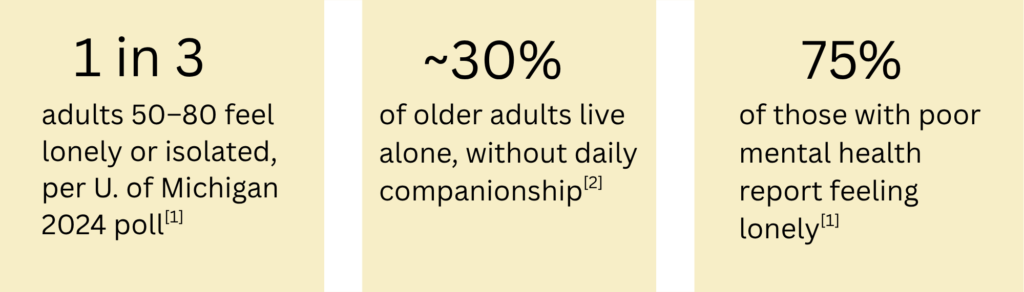
Loneliness is not a character flaw or a sign of weakness. It is the result of real life circumstances: adult children moving away, retirement ending daily work friendships, health changes limiting mobility, and the gradual loss of peers. These are societal shifts, not personal failures.
Why this matters for your health
In May 2023, U.S. Surgeon General Dr. Vivek Murthy issued a landmark advisory declaring loneliness a national epidemic. His warning was direct: the health consequences of being socially disconnected are comparable to smoking up to 15 cigarettes a day.[3]
“Loneliness is far more than just a bad feeling. It harms both individual and societal health. It is associated with a greater risk of cardiovascular disease, dementia, stroke, depression, anxiety, and premature death.” — U.S. Surgeon General Dr. Vivek Murthy, 2023[3]
The specific risks are well documented. According to the Surgeon General’s report, insufficient social connection is linked to a 29% higher risk of heart disease, a 32% higher risk of stroke, and a 50% higher risk of developing dementia in older adults.[4] The CDC also notes that social isolation is independently associated with a 50% increased risk of dementia, making connection just as important to brain health as mental exercise or diet.[5]
These are not abstract statistics. They represent real outcomes that can be shaped by the quality and frequency of our connections with other people.
Why seniors are more vulnerable
Several life changes converge in the post-50 years that can quietly erode social networks. Research consistently identifies the following as key risk factors for loneliness in older adults:[6]
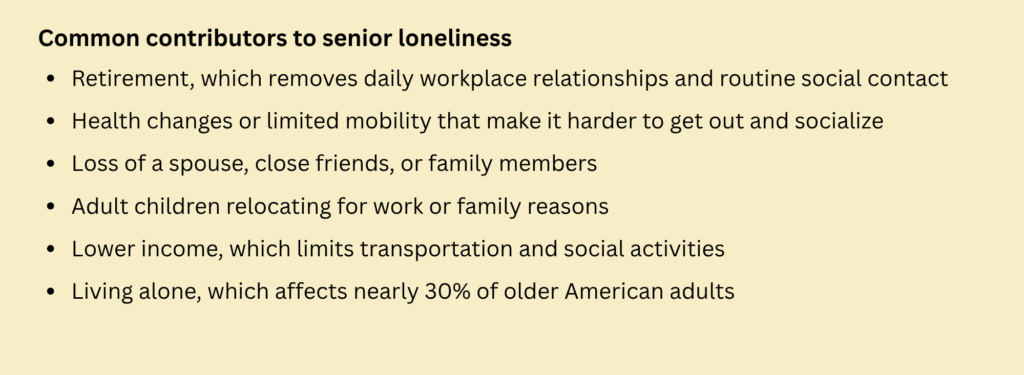
Those with poor physical or mental health face compounding challenges. Older adults in fair or poor health report loneliness at rates more than double those of their healthier peers.[1] This creates a difficult cycle: poor health increases isolation, and isolation worsens health.
Technology as a tool, not a threat
Many older adults approach phones, tablets, and apps with understandable hesitation. Technology can feel overwhelming, and there is a reasonable worry about privacy or being targeted by scammers. These concerns deserve respect. But research suggests that when technology is used with a clear purpose, it can meaningfully reduce feelings of isolation.[7]
A systematic review published in medical literature found that technology use reduces loneliness both directly and indirectly, and can strengthen social support in ways that build resilience among older adults.[8] The key word is purpose. Using a tablet to video-call a grandchild every Sunday is fundamentally different from scrolling through social media alone at midnight.
The good news is that you do not need to master everything at once. One device, one or two apps, and one consistent weekly connection is enough to begin.
The best digital tools for staying connected
Here are the most practical, senior-friendly options available today:
Video calling
FaceTime (for Apple devices), Whatsapp Video on any phone, Zoom, and Google Meet allow face-to-face visits regardless of distance. By 2020, one in three seniors were using video chat weekly.[9] Zoom supports group calls with multiple people, ideal for family catch-ups or virtual book clubs.
Messaging apps
WhatsApp and Facebook Messenger allow photos, voice messages, and quick check-ins. These are low-pressure ways to stay in touch daily without needing to arrange a formal call.
Senior Planet Community
A free platform designed for adults 60 and older, with groups for gardening, travel, fitness, books, and more. It offers a simpler layout than most social media and includes digital literacy support.[10]
Facebook Groups
With 71% of adults over 50 using Facebook, this remains the most familiar platform.[10] Interest-based groups for gardening, genealogy, cooking, and local events make it easy to connect around shared topics.
According to AARP, services like FaceTime, Zoom, and Google Meet offer straightforward ways to see the people you care about, and some streaming platforms even offer “watch parties” where friends can view the same show together remotely while chatting.[11]
When technology leads back to real life
Digital tools work best not as substitutes for in-person contact, but as bridges that make real-world connection easier to organize and maintain. A group chat can coordinate a weekly coffee. A video call can keep a friendship alive until the next visit. An online community can spark a shared interest that eventually leads to joining a local club.
Virtual communities offer particular benefits for older adults facing mobility challenges or geographic distance, enabling them to participate in book clubs, cooking classes, guided museum tours, and more from the comfort of home.[12] These digital experiences can supplement rather than replace in-person life.
One practical tip: treat technology connections the way you would treat any appointment. A scheduled Wednesday evening call is far more likely to happen than a vague plan to “catch up sometime.”
A simple starting point
If all of this feels like a lot, that is understandable. The goal is not to become a technology expert. Here is a gentle plan to get started:
Your three-step starting plan
- Pick one device you already own, whether a smartphone, tablet, or computer
- Choose one app: video calling for family, or a group for a hobby you love
- Schedule one weekly connection and protect that time like any other appointment
If you need help getting started, many local libraries, senior centers, and community organizations offer free one-on-one technology assistance. AARP also offers free online workshops for older adults learning to use digital tools. You do not have to figure it out alone.
One important caution: be thoughtful about online safety. The FBI reports that older adults lost over $4.8 billion to internet fraud in 2024.[9] Never share personal financial information online, be cautious about connecting with strangers, and when in doubt, ask a trusted family member or friend for a second opinion.
Loneliness is not inevitable.
Connection is achievable at any age.
Aging well means aging together.
Sources
- [1] University of Michigan National Poll on Healthy Aging (2024). Loneliness and Isolation: Back to Pre-Pandemic Levels, But Still High, for Older Adults. ihpi.umich.edu
- [2] National Institute on Aging / National Institutes of Health. Cited in Medflyt Home Care Blog (2024). medflyt.com
- [3] U.S. Surgeon General Dr. Vivek Murthy (2023). Advisory on the Epidemic of Loneliness and Isolation. hhs.gov
- [4] New York State Office for the Aging, citing Surgeon General’s report (2023). aging.ny.gov
- [5] Centers for Disease Control and Prevention. Health Risks of Social Isolation and Loneliness. cdc.gov
- [6] Scoping review: Uncovering the impact of loneliness in ageing populations. PMC (2024). pmc.ncbi.nlm.nih.gov
- [7] Systematic Review: The Effect of Technology Use in Reducing Social Isolation or Loneliness in Older Adults. PMC (2020). ncbi.nlm.nih.gov
- [8] Technology and Social Isolation, Loneliness, and Health Inequities Among Older Adults. PMC (2022). ncbi.nlm.nih.gov
- [9] SeniorSite: Best Apps for Seniors to Make Friends (2026). seniorsite.org
- [10] SeniorLiving.org: Best Social Media Apps for Seniors in 2026. Citing 2023 AARP research. seniorliving.org
- [11] AARP: How Technology Can Help Older Adults Fight Loneliness. aarp.org
- [12] Senior Lifestyle: Online Communities for Seniors: How to Find Friends Online. seniorlifestyle.com


