If you were suddenly unable to speak for yourself tomorrow, would your adult children know exactly what you would want?
A hospital hallway is not where you or your family want to have your first real conversation about finances, medical wishes, or living arrangements. Yet that is exactly where so many families end up, because the easier conversation, the one that could have happened at a kitchen table months or years earlier, kept getting put off. In my line of work, I have sat with families in that hallway moment more times than I can count. The families who fare best are almost always the ones who talked things through before a crisis forced their hand.
Important conversations are often postponed because they feel uncomfortable. Unfortunately, emergencies rarely wait until families are ready. Planning ahead protects your independence and gives your loved ones confidence when difficult decisions arise.
This article walks through why these conversations get delayed, what topics actually need to be covered, and how to open the discussion in a way that respects everyone’s dignity and independence.
Why Families Avoid These Conversations
Many families avoid these conversations because they fear conflict or believe there will always be more time. Research suggests many adults have not completed basic estate planning or discussed their wishes with loved ones. As a result, adult children are often left making important decisions without guidance.
The data on this is sobering. Fewer than a third of American adults have created a will, and about the same share have a living will or advance health care directive, according to a Pew Research Center survey of 8,750 U.S. adults conducted in September 2025. Most people do not put these documents in place until their seventies. Roughly two thirds of adults in their seventies have a will, and about eight in ten of those 80 and older have completed one, the same Pew survey indicates.
The 2026 Estate Planning Report from Trust and Will, based on a survey of 5,000 U.S. adults, found that 56 percent of Americans currently have none of the five core estate planning documents the survey tracked, and 27 percent say they have never discussed their end of life wishes with loved ones and have no plans to. That silence carries a cost, and it usually lands on adult children at the worst possible moment.
Money is often the hardest topic of all. Per a Finance of America survey conducted in late 2025, only 39 percent of respondents had discussed their parents’ finances with them in the past year, even though most agreed that having the conversation would help them plan rather than scramble later.
None of this means families do not care. It means the conversation feels awkward, mortality feels far away until it suddenly is not, and nobody wants to be the one who brings it up first.
Six Topics Every Family Should Discuss
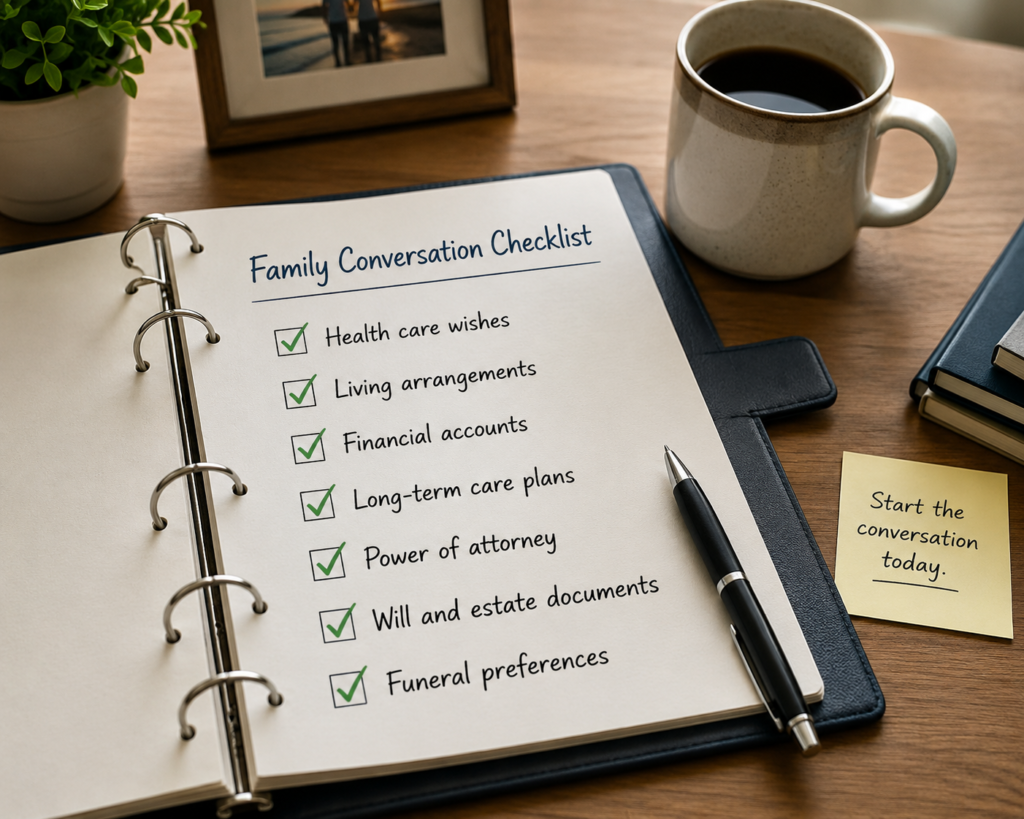
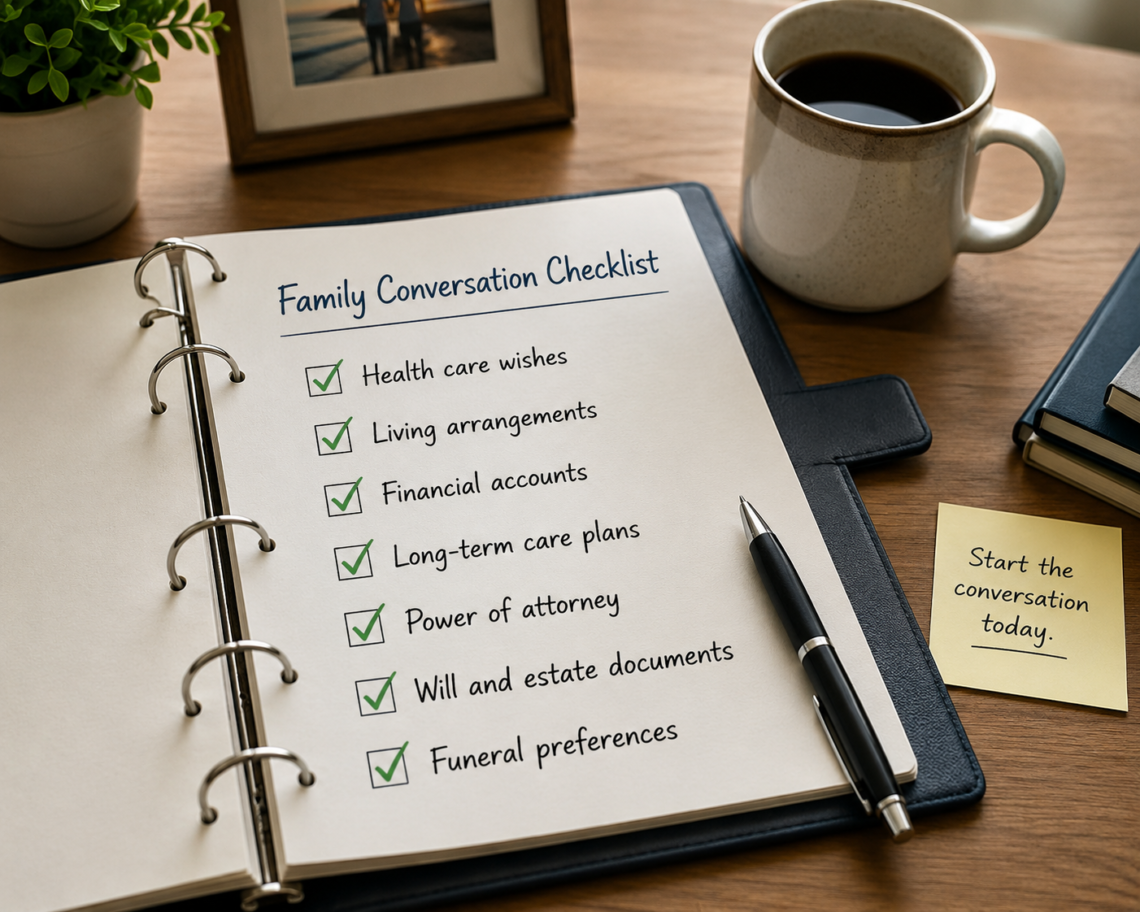
A single talk rarely covers everything, and it does not need to. Think of this as a short list of subjects to work through over time, not a one-time interrogation. Discuss health care wishes, who will make medical decisions, where you want to live as you age, finances, insurance, long-term care, legal documents, digital accounts, passwords, funeral preferences, and how to access important records.
Health Care Wishes
This includes who is authorized to make medical decisions if you cannot speak for yourself, and what kind of care you would or would not want. According to the same Pew Research survey, most parents age 65 and older who have talked with their adult children say they have shared their wishes for medical care, at 66 percent, though the share drops among younger parents in their sixties. A health care surrogate designation and a living will are the documents that typically capture these wishes in Florida.
Where You Want to Live as You Age
Living arrangements are the topic families discuss least. Only 44 percent of older parents in the Pew survey said they had discussed their preferences for living arrangements if they could no longer live independently, the lowest share of any topic measured. This is understandable, since it touches on independence and identity, but it is also the decision most likely to require a fast turnaround if a fall or a hospital stay forces the issue.
Finances and Long-Term Care Coverage
Where accounts are held, whether there is long term care insurance, what monthly income looks like, and who holds power of attorney all belong in this conversation. Families who skip it often end up piecing this information together during a hospitalization, which is the worst possible time to be tracking down account numbers.
Legal Documents
A will, a durable power of attorney, and a health care surrogate designation are the core documents most elder law attorneys recommend. Per the Trust and Will report, among Americans who do have documents in place, a will is the most common at 26 percent, followed by a medical power of attorney or advance directive at 19 percent.
Funeral and Burial Preferences
This is, somewhat surprisingly, the topic families discuss most often. Sixty eight percent of older parents in the Pew survey said they had shared their burial or funeral preferences with their adult children. It is often easier to talk about than medical or housing decisions, so some families use it as a natural entry point into the harder subjects.
A woman in her late seventies, living alone, had a fall in her kitchen. Her adult daughter, who lives out of state, has never discussed her mother’s finances, medical wishes, or long-term care preferences with her. When the hospital asked who holds health care power of attorney, no one had an answer. The daughter spent the next several weeks searching for account statements, insurance policies, and a doctor who could explain her mother’s baseline health, all while trying to make decisions under pressure. This aligns closely with what the Finance of America survey found about families who had not yet discussed a parent’s finances, and it is precisely the situation that a documented health care surrogate and an earlier conversation could have prevented. If this conversation had already happened, the daughter would have a health care surrogate designation on file, a list of accounts and providers, and a clear sense of her mother’s wishes, allowing her to advocate for her mother immediately instead of losing critical time trying to obtain information.
How to Open the Conversation
- Pick a calm moment, not a crisis. A holiday visit or a quiet Sunday afternoon works better than a hospital waiting room.
- Start with a story or a news item rather than a direct demand. Mentioning a friend’s experience with an unexpected hospitalization can open the door naturally.
- Frame it as protecting their wishes, not taking away their independence. Most parents want their preferences honored, and documenting them is how that happens.
- Break it into smaller conversations. Cover one topic at a time rather than trying to resolve everything at once.
- Put it in writing once you agree on the basics. A conversation without documentation still leaves gaps when decisions have to be made quickly.
- Loop in professionals where needed. An elder law attorney, a financial planner, or a licensed care coordinator can make the technical parts easier for everyone.
Making It an Ongoing Conversation
The families who handle a health crisis well are rarely the ones who had one perfect conversation. They are the ones who kept talking, a little at a time, over months or years, updating the plan as circumstances changed. Advance care planning is described by the National Committee for Quality Assurance as a continuous process rather than a single event, and that framing applies just as well to financial and living arrangement discussions. Revisiting the plan once a year, or after any major health change, keeps it accurate and keeps the conversation from feeling like a one-time ordeal.
Waiting for a crisis to force the issue almost always means less time, less clarity, and more stress for everyone involved. Starting the conversation now, even in small pieces, is one of the most protective things a family can do for each other.
I am not an attorney, and nothing in this article is legal advice. This information is provided for educational purposes only. Please consult a licensed attorney for guidance specific to your situation.
Sources
Pew Research Center, “Experiences With Estate Planning and Discussing End-of-Life Preferences,” survey of 8,750 U.S. adults conducted September 2-8, 2025. pewresearch.org
Trust & Will, “2026 Estate Planning Report,” survey of 5,000 U.S. adults conducted January 28 to February 5, 2026. trustandwill.com
Finance of America survey, cited in “Gen X Is Crushed Between Children and Aging Parents,” Money Talks News, January 2026. moneytalksnews.com
Pew Research Center, “More Than Half of Americans in Their 40s Are ‘Sandwiched’ Between an Aging Parent and Their Own Children,” April 2025. pewresearch.org
National Committee for Quality Assurance (NCQA), “Advance Care Planning (ACP).” ncqa.org


