Please note: I am not an attorney or financial advisor. The information in this article is for educational purposes only and does not constitute legal or financial advice. Please consult a qualified attorney, financial advisor, or tax professional for guidance specific to your situation.
For many retirees, the family home is far more than bricks and mortar. It is where children were raised, holidays were celebrated, and decades of memories were made. But it is also one of the most valuable financial assets most people will ever own, and for a growing number of older Americans, it may be the key to a more secure retirement.
According to the National Reverse Mortgage Lenders Association (NRMLA) and RiskSpan, housing wealth among homeowners ages 62 and older climbed to a record $14.66 trillion in the third quarter of 2025. Yet despite sitting on this extraordinary wealth, many retirees never consider their home as a retirement resource.
Vanguard research indicates that only about 40 percent of baby boomers nearing retirement are expected to have enough savings to maintain their lifestyle, and that fully leveraging housing wealth could boost retirement readiness by as much as 20 percent. Per the National Association of Realtors (NAR), for many middle-class homeowners, their home is their single largest asset as they transition into retirement.
Over the years, I have met many retirees who were struggling to make ends meet while living in homes with hundreds of thousands of dollars in untapped equity. They worried about rising insurance premiums, property taxes, healthcare expenses, and inflation, yet never considered that the home itself could become part of their retirement strategy.
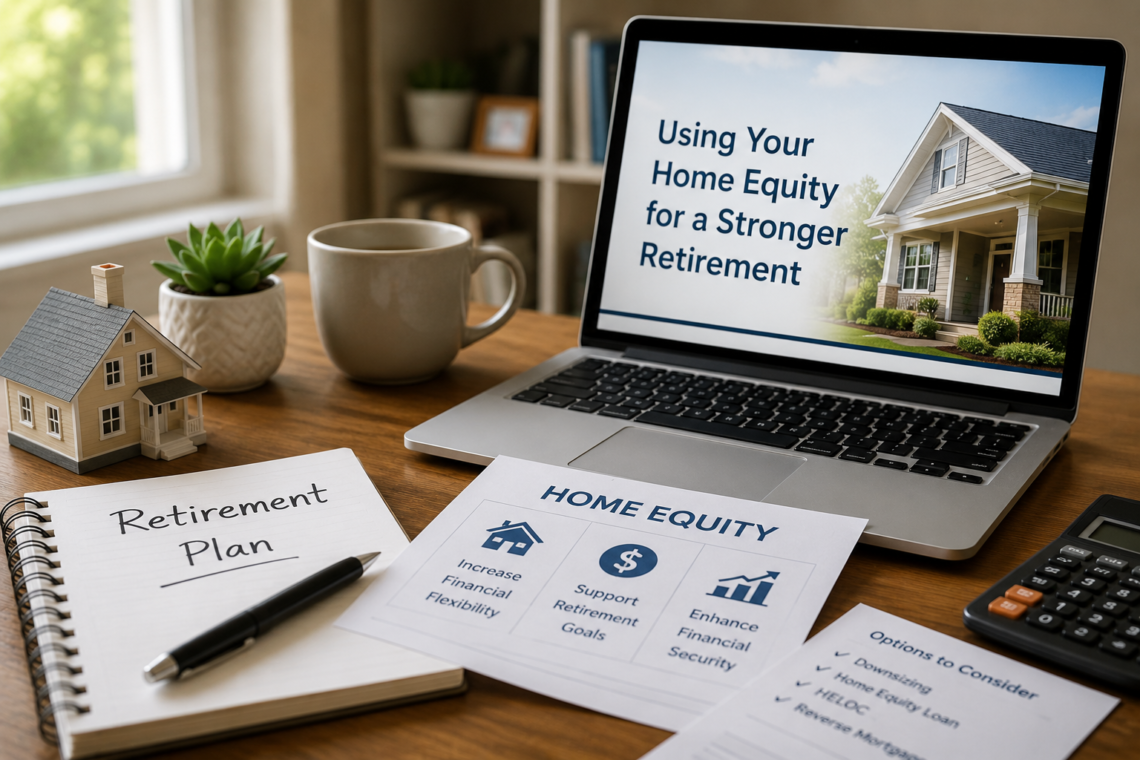
Your home equity is not just something your heirs inherit one day. When used wisely, it can become a valuable financial resource that helps you maintain independence, improve your quality of life, and face retirement with greater confidence. Let’s look at several ways homeowners can put that equity to work.
Downsizing: Turning Equity into Financial Freedom
For many retirees, downsizing is one of the most straightforward and powerful ways to unlock home equity. Selling a larger home and purchasing a smaller, more affordable property can accomplish several goals at once.
- Free up a substantial amount of cash from built-up appreciation
- Reduce or eliminate monthly mortgage payments
- Lower ongoing property taxes and homeowners insurance costs
- Reduce maintenance and upkeep expenses
- Simplify daily living in a home better suited to your current needs
According to ATTOM, the typical home seller in 2024 made a profit of $122,500. For retirees who have owned their homes for twenty or thirty years, gains can be significantly higher, particularly in strong markets like South Florida.
There is also a potential tax benefit to consider. The Internal Revenue Service (IRS), under Section 121 of the Internal Revenue Code indicates that homeowners who meet the ownership and use requirements may exclude up to $250,000 in capital gains from the sale of their primary residence, or up to $500,000 if married and filing jointly. To qualify, the homeowner generally must have owned and lived in the home as their primary residence for at least two of the five years leading up to the sale. Because every tax situation is different, it is essential to consult a qualified tax professional before making any decisions.
A retired couple I worked with had lived in the same four-bedroom home for more than thirty years. Their children had long since moved out, and yet they continued maintaining a house far larger than they needed. Initially, they believed the emotional and logistical cost of moving would not be worth it.
After reviewing their options, we found a beautiful single-story home in a nearby 55-plus community. The sale of their previous home generated enough equity to purchase the new home outright, with a meaningful amount left over earmarked for future healthcare expenses. Months later, they shared that the greatest surprise was not just the financial relief. It was how much less stressful their lives had become and how much more time they had to actually enjoy retirement.
Their experience reflects what many retirees discover: the emotional attachment to a large home can sometimes overshadow the very real burden of maintaining it.
Home Equity Loans and HELOCs: Accessing Cash While Staying in Place
Not everyone wants to sell their home, and that is perfectly understandable. If the goal is to access cash while continuing to live in your current residence, a home equity loan or a Home Equity Line of Credit (HELOC) may be worth exploring with a qualified lender.
Both products allow you to borrow against the equity you have built in your home. A home equity loan typically provides a lump sum with a fixed interest rate and fixed monthly payments. A HELOC functions more like a credit line, allowing you to borrow as needed up to an approved limit, and often carries a variable interest rate. Common uses include major home repairs, accessibility renovations, medical expenses, debt consolidation, and emergency reserves.
However, as the AARP Public Policy Institute cautions, both home equity loans and HELOCs use your home as collateral. Missing payments could put your home at risk. Lori Trawinski, director of finance and employment at the AARP Public Policy Institute, has noted that credit card debt is unsecured, while home equity debt is secured, meaning the consequences of default are far more serious.
Interest rates, repayment terms, fees, and borrowing costs should always be carefully reviewed with your lender and financial advisor before moving forward. Retirees with limited or fixed income should pay particular attention to repayment requirements over time.
One homeowner reached out to me believing that selling her home was the only way to afford extensive accessibility modifications after a medical diagnosis. After discussing her goals in depth, I encouraged her to explore every available option with her financial and legal professionals before listing the property.
She ultimately qualified for a home equity loan that allowed her to install wheelchair ramps, widen doorways, renovate her bathroom for safety, and improve lighting throughout the home. Rather than leaving the neighborhood she had called home for decades, she was able to remain safely in her house while preserving much of the equity she had spent years building.
Her experience is a reminder that selling is not always the only path forward, and that speaking with a financial professional early can open options that may not be immediately obvious.
Reverse Mortgages: Understanding the Facts
Few financial products generate as much confusion and skepticism as the reverse mortgage. Unfortunately, many retirees dismiss this option based on outdated information or misconceptions passed along over the years. While a reverse mortgage is not appropriate for everyone, it can be a meaningful financial planning tool for certain homeowners.
The most common type is the Home Equity Conversion Mortgage (HECM), which is the only reverse mortgage insured by the federal government. Per the U.S. Department of Housing and Urban Development (HUD), the HECM allows eligible homeowners ages 62 and older to withdraw a portion of their home’s equity to use for home maintenance, repairs, or general living expenses.
The Consumer Financial Protection Bureau (CFPB) states that to qualify for a HECM, the home must be the borrower’s primary residence, and the borrower must own the home outright or have significant equity. Federal law also requires that all prospective borrowers complete a counseling session with a HUD-approved housing counselor before the loan can proceed, ensuring borrowers fully understand the terms, obligations, and alternatives.
Unlike a traditional mortgage, borrowers are not required to make monthly mortgage payments on the loan balance, provided they continue meeting program obligations. These include paying property taxes, maintaining homeowners insurance, keeping the home in reasonable condition, and continuing to live there as their primary residence. The loan typically becomes due when the borrower sells the home, permanently moves out, or passes away.
It is important to note that a reverse mortgage can affect eligibility for Medicaid benefits, and heirs will generally have a limited window to repay the lender after the borrower’s passing. Per Bankrate, some financial specialists view a reverse mortgage as a tool of last resort rather than a first option. This makes professional guidance and HUD-approved counseling especially important before proceeding.
I once met with a widow who had owned her home free and clear for nearly twenty years. Although her property had appreciated significantly, her monthly income consisted primarily of Social Security and a small pension. As healthcare costs continued to climb, she became increasingly concerned about her ability to pay for future in-home assistance while remaining independent.
Rather than immediately selling the home she loved, we discussed the importance of understanding every available option first. She eventually met with a HUD-approved housing counselor and a reverse mortgage specialist to learn more about the HECM program. After carefully reviewing the costs, responsibilities, and alternatives with her financial advisors, she determined that a reverse mortgage aligned with her long-term goals.
The additional funds helped her cover home maintenance and in-home support services, allowing her to remain comfortably in the home where she had lived for more than forty years. Her situation illustrates why it is so important not to dismiss any option without first getting the full picture from qualified professionals.
Choosing the Right Strategy for Your Situation
There is no one-size-fits-all answer when it comes to using home equity in retirement. What works well for one family may not be the right fit for another. The most appropriate strategy will depend on a range of personal and financial factors, including:
- Your age and overall health
- Your current retirement income and projected expenses
- The amount of equity built up in your home
- Your estate planning goals and wishes for heirs
- Current housing market conditions in your area
- Long-term care expectations and healthcare costs
- Whether you have an existing mortgage balance
Research from NAR indicates that homeowners in their 60s have typically owned their home for more than two decades, which translates to roughly $200,000 or more in accumulated housing wealth from price appreciation alone. For many middle-income retirees, that equity represents five times their median retirement savings. Understanding how to access it wisely can make a meaningful difference.
Your home is much more than a place to live. For millions of retirees, it is also one of the most powerful tools available to support long-term financial security.
Whether you are considering downsizing to simplify your life and free up cash, exploring a home equity loan for specific needs, or taking the time to genuinely understand whether a reverse mortgage could work for your situation, the important first step is simply to get informed.
Throughout my years working with seniors and their families, one of the most common things I have seen is people assuming they have only one option when financial challenges arise. More often than not, that simply is not true. Having accurate information, asking the right questions, and working with trusted professionals can open doors that many people never realized existed.
Every financial decision should be made only after consulting with qualified professionals, including your financial advisor, tax professional, attorney, and, where appropriate, a HUD-approved housing counselor. Together, they can help you determine the strategy that best supports your retirement goals while protecting the home you have worked so hard to build.
Please note: I am not an attorney or financial advisor. The information in this article is for educational purposes only and does not constitute legal or financial advice. Please consult a qualified attorney, financial advisor, or tax professional for guidance specific to your situation.
Sources
National Reverse Mortgage Lenders Association (NRMLA) / RiskSpan. “Senior Home Equity Surges to Record $14.66 Trillion in Q3 2025.” NRMLA, January 2026. reversemortgage.org
Vanguard. “Home Equity: A Powerful Tool for Retirement Security.” Vanguard Corporate, November 2025. corporate.vanguard.com
National Association of Realtors (NAR). “Americans Have Just $1K Saved for Retirement: Home Equity May Be Their Lifeline.” NAR Magazine, February 2026. nar.realtor
ATTOM. “Home Seller Profits.” Referenced via Bankrate, February 2025. bankrate.com
Internal Revenue Service (IRS). “Topic No. 701, Sale of Your Home.” IRS, 2025. irs.gov/taxtopics/tc701
Internal Revenue Service (IRS). “Publication 523, Selling Your Home.” IRS, 2025. irs.gov/publications/p523
U.S. Department of Housing and Urban Development (HUD). “FHA Reverse Mortgage for Seniors (HECM).” HUD.gov. hud.gov
Consumer Financial Protection Bureau (CFPB). “Can Anyone Take Out a Reverse Mortgage Loan?” CFPB, 2025. consumerfinance.gov
AARP Public Policy Institute. “Reverse Mortgages.” AARP Policy Book. policybook.aarp.org
Bankrate. “Home Equity Strategies for Older Homeowners.” Bankrate, February 2025. bankrate.com
Bankrate. “Should Retirees Use Their Homes to Pay Bills?” Bankrate, October 2024. bankrate.com


