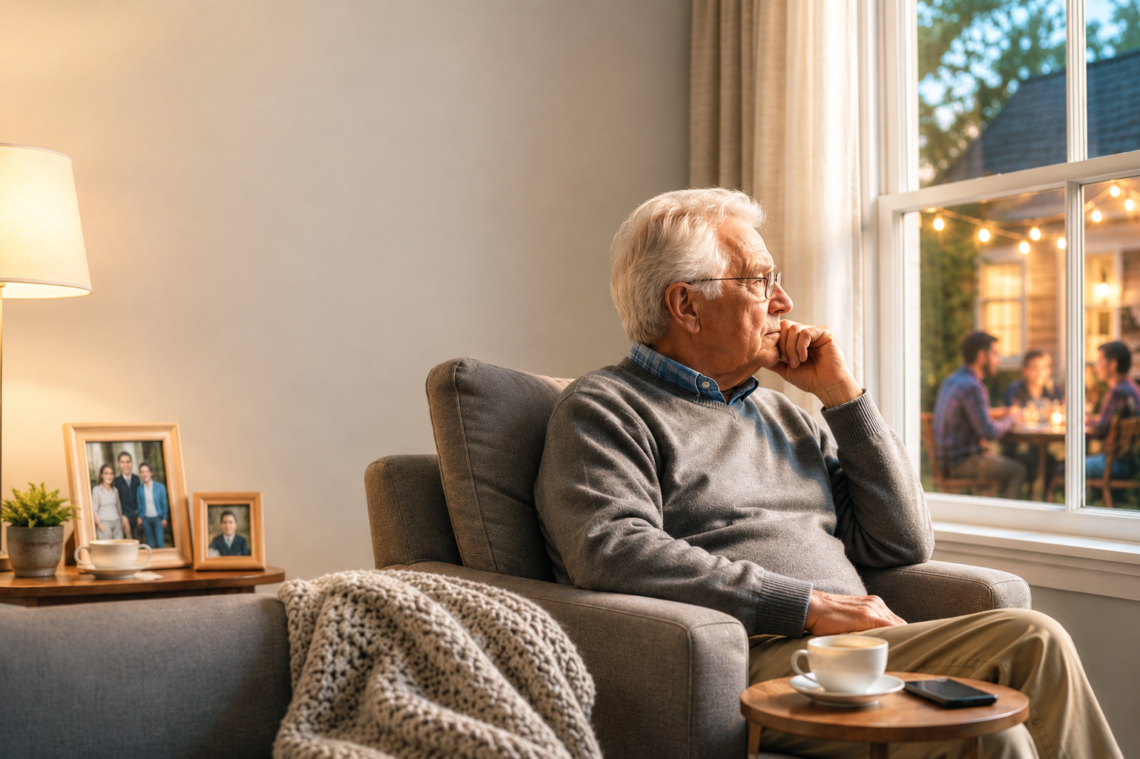
Why Senior Loneliness Is the Epidemic No One Talks About — and What You Can Do Today
📖 6–7 minute read • Written for adults, caregivers, and families

Here’s something your doctor probably hasn’t told you: being lonely is as dangerous to your health as smoking 15 cigarettes a day. Not figuratively – literally. The U.S. Surgeon General declared loneliness a national epidemic, and older adults are among the most vulnerable.
Yet for many seniors, loneliness creeps in quietly. It doesn’t arrive with fanfare. It shows up in the long Sunday afternoons when the phone doesn’t ring. In the dinners eaten alone. In the realization that you can’t remember the last time someone asked, “So, how are you really doing?”
The good news? This is a solvable problem – and in 2026, there are more tools, communities, and opportunities than ever before to help seniors build the vibrant social lives they deserve. This post is your roadmap.
Why Loneliness Hits Harder After 60
Life after 60 naturally brings transitions that can quietly erode a person’s social world. Retirement removes the built-in daily interaction with colleagues. Children grow up and move away. Friends and spouses pass on. Mobility challenges can make leaving the house less spontaneous. And our culture, which prizes youth and productivity, often sidelines older adults in subtle ways.
According to a 2025 AARP study, more than one in three adults over 65 report feeling lonely on a regular basis. Among those living alone – which represents about 28% of seniors – the numbers are even higher.
And here’s what makes this a true health emergency: chronic loneliness raises the risk of dementia by 50%, increases the likelihood of heart disease and stroke, weakens the immune system, and is linked to significantly higher rates of depression and anxiety. The body responds to prolonged social isolation the same way it responds to physical danger — with stress hormones that, over time, break down the cardiovascular and immune systems.
This isn’t about being shy or introverted. Many deeply social people find themselves isolated in later life through circumstance, not personality. Recognizing this distinction is the first step toward change.
The Loneliness-Health Connection: What the Science Says
Dr. Vivek Murthy, in his landmark 2023 advisory on the loneliness epidemic, summarized decades of research with a striking conclusion: social connection is a fundamental human need, as essential as food, water, and shelter. When that need goes unmet, the consequences are physical, not just emotional.
Key research findings include:
- Socially connected seniors live, on average, 7 years longer than their isolated peers.
- Loneliness accelerates cognitive decline – lonely seniors score worse on memory tests and are at dramatically higher risk for Alzheimer’s disease.
- Strong social ties reduce inflammation markers in the blood, protecting the heart and reducing cancer risk.
- Seniors who participate in regular group activities report 40% lower rates of depression.
- Even brief, meaningful social interactions – a conversation with a neighbor, a coffee with a friend – produce measurable improvements in mood and cognitive function.
The takeaway is clear: building and maintaining social connections isn’t a “nice to have” in later life. It’s a prescription for a longer, healthier, happier existence.
7 Proven Ways to Build Real Connection After 60
You don’t have to overhaul your life to fight loneliness. Small, consistent actions are often more powerful than dramatic changes. Here are seven approaches backed by both research and real-life success stories:
1. Join a Class or Club Built Around What You Already Love
Whether it’s gardening, watercolor painting, woodworking, or birding — there’s almost certainly a group near you or online that shares your passion. The magic of interest-based groups is that you skip the awkward “getting to know you” phase. You already have something to talk about. Check your local library, senior center, parks and recreation department, or sites like Meetup.com.
2. Volunteer — Especially in Roles That Match Your Expertise
Volunteering is one of the most powerful antidotes to loneliness because it creates a sense of purpose alongside social connection. Research shows that seniors who volunteer at least two hours per week experience significantly lower rates of depression and report higher life satisfaction. Consider mentoring programs, hospital volunteering, literacy programs, or even helping at your local animal shelter. AARP’s Create the Good program and VolunteerMatch.org are excellent starting points.
3. Embrace Technology — Seriously
Smartphones, tablets, and video calling apps have made distance irrelevant. Seniors who learn to use FaceTime, Zoom, or WhatsApp maintain stronger relationships with faraway family and friends. Many libraries offer free technology classes specifically for seniors. And platforms like Stitch (a social network built exclusively for adults over 50) make it easy to meet peers online and arrange in-person meetups.
4. Explore Faith and Spiritual Community
For many seniors, faith communities provide some of the richest and most reliable social networks available. Churches, mosques, synagogues, temples, and other places of worship often have robust social programming — from Bible studies to outreach groups to shared meals. Even for those who aren’t deeply religious, many spiritual communities warmly welcome anyone seeking connection and belonging.
5. Consider Intergenerational Connection
Some of the most meaningful relationships for seniors come from unexpected age gaps. Programs that pair seniors with college students, young families, or teens — whether through mentorship, shared housing, or community events — report high satisfaction on both sides. Young people bring energy and novelty; seniors bring wisdom, patience, and perspective. It’s a genuine two-way exchange.
6. Walk With a Purpose — and a Partner
Walking groups combine the health benefits of physical activity with consistent social interaction. Many senior centers, YMCAs, and neighborhoods run organized walking groups that meet weekly or even daily. The regularity of a walking group creates exactly what isolated seniors often lack: reliable, scheduled human contact with people who are glad to see them.
7. Simply Say Yes More Often
Sometimes the simplest intervention is the most powerful. If a neighbor invites you to coffee, say yes. If your church is hosting a potluck, bring a dish. If your grandchild asks you to video call, pick up. Loneliness can create a cycle of withdrawal — the more isolated we feel, the harder it becomes to reach out. Breaking that cycle often starts with one small yes.
A Word for Caregivers and Family Members
If you’re reading this for a parent, spouse, or friend rather than yourself — your instinct to help is one of the most important things you can offer. But there’s a nuance worth noting: well-meaning family members sometimes inadvertently create barriers to social connection by being overprotective, or by substituting family contact for peer contact.
What seniors need most is peer connection — relationships with people who are at the same life stage, who share the same cultural references, who understand what it means to navigate the particular challenges and joys of later life. Family love is irreplaceable, but it can’t substitute for friendship with equals.
The best thing caregivers can do is gently facilitate connection: help set up technology, provide transportation to classes or clubs, research local programs, and then step back and let the senior take ownership. Independence and agency are themselves powerful protectors against loneliness.
You Deserve a Life Full of People Who Know Your Name
There’s a reason the research on social connection and longevity is so consistent: human beings are wired for community. We evolved in tribes. We heal in community. We thrive when we feel seen, known, and needed.
If you’re a senior reading this and loneliness has become familiar — please know this: it is not a permanent condition, and it is not your fault. It is a circumstance, and circumstances can change. One phone call, one class, one “yes” can be the beginning of something you didn’t expect.
The world needs what you carry — your stories, your experience, your presence. And the right people are out there, waiting to meet you.
─────────────────────────────────────────
Share this post if it resonated with you. Tag a senior in your life who deserves to see it. And drop a comment below: What’s one way you’ve stayed connected as you’ve gotten older? We’d love to hear your story.


